Natarajasana (Dancer Pose / Lord of the Dance)
Table of Contents
- Introduction
- How to Do Natarajasana
- Benefits
- Tips for Better Practice
- Why Learn with a Yoga Teacher or Instructor
- Cautions and Contraindications
- Conclusion
- FAQS
Introduction
Natarajasana stands out as one of the most iconic and frequently photographed elements within advanced standing yoga poses. The standing balance on one leg, the other leg lifted and arched behind, the arm reaching back to hold the foot, the whole body in a graceful backbending arc — it reads as beautiful in a way that not all yoga postures do.
What the photos don’t capture is how much it falls apart in the first hundred attempts.
Nataraja is another name for Shiva in his form as Lord of the Dance — the cosmic dancer whose movement creates and destroys the universe. The pose embodies that dynamic, unstable, movement-filled quality. It is a highly demanding option among complex yoga balance poses, serving as a balance pose, a backbend, a hip flexor stretch, a shoulder opener, and a concentration exercise simultaneously.
Getting all of those things to happen at the same time takes time. The balance requires stable single-leg standing. The backbend requires thoracic (the middle and upper back section of the spine) and lumbar (the lower back region of the spine) flexibility. The foot-hold requires shoulder flexibility. Each of these can be the limiting factor, and they’re all needed at once.
How to do Dancer Pose with correct alignment
Stand in Tadasana. Fix the gaze on a still point at eye level.
Shift the weight onto the right foot. Bend the left knee and lift the left foot behind you. Reach back with the left hand and grasp the inner left ankle or the top of the left foot — the hand holding from the inside of the foot.
Inhale and raise the right arm overhead, palm facing forward or inward.
Now the simultaneous action: press the left foot back and upward into the hand while the hand resists forward. This creates the arc of the body — the foot pressing back creates the backbend, which lifts the chest, which creates the shape. If the hand just holds passively, the pose collapses.
The torso leans forward slightly as the back leg rises. The right arm reaches forward and up. Hold for 20 to 45 seconds. Lower on an exhale and repeat on the left side.
If you are just starting out with this complex posture, seeking out Lord of the Dance pose modifications for beginners—such as resting your extended hand against a wall—will help stabilize your structure.
Benefits
Single-leg balance and hip stability. The standing leg works very hard in Natarajasana. All the ankle, knee, and hip stabilizers of the standing leg engage throughout the hold. This builds functional single-leg stability that transfers to gait, running, and most sport movements.
Deep hip flexor and quadriceps stretch. The raised and back-extending leg gets a significant stretch along the front of the thigh — rectus femoris and iliopsoas — as it moves into extension. The depth of this stretch increases as the foot pushes higher, making the hip flexor opening more progressive than in many other postures.
Thoracic and lumbar backbend. The whole spine extends into a backbend as the foot presses back. The chest lifts, the thoracic spine opens, the lumbar extends. This is a dynamic backbend that the foot’s pressing action creates rather than a passive shape.
Shoulder flexibility. Reaching the arm back and holding the inner ankle requires the shoulder to be in significant internal rotation with the arm behind the body. This is a range of shoulder motion that most people limit and that Natarajasana specifically works on.
Concentration under complexity. Managing balance, backbend, arm reach, and the breathing that keeps it all from locking up simultaneously is an exercise in distributed attention that no simple posture provides.
Tips for Better Practice
- Press the foot back into the hand. This is the most important instruction in the pose and the one most beginners miss. Passively holding the foot doesn’t create the backbend. The active pressing of the foot against the resisting hand is what arcs the spine and lifts the chest.
- Use a strap if the hand doesn’t reach the foot. Loop a strap around the ankle and hold the strap. This is not a lesser version — it’s the version that allows the pose to work for people whose shoulder flexibility isn’t yet sufficient for the direct hold.
- Hinge the torso forward. As the back leg rises, the torso naturally inclines forward to counterbalance. This is correct, not a fault. Work with it rather than fighting to stay vertical.
- The standing knee should be soft, not locked. A locked knee is vulnerable in a balance pose. A soft, gently engaged knee is stable.
- Fall without frustration. Natarajasana falls down. Everyone falls in this pose, including advanced practitioners. The falling is part of the practice — how you return to it is the work.
Why Learn with a Yoga Teacher or Instructor
The “press the foot back” instruction changes the whole experience of the pose, and it’s one that’s hard to understand from a written description alone. A teacher demonstrating and verbally cueing the foot-press action while watching whether it’s actually happening produces the pose more quickly than any amount of solo practice without that cue.
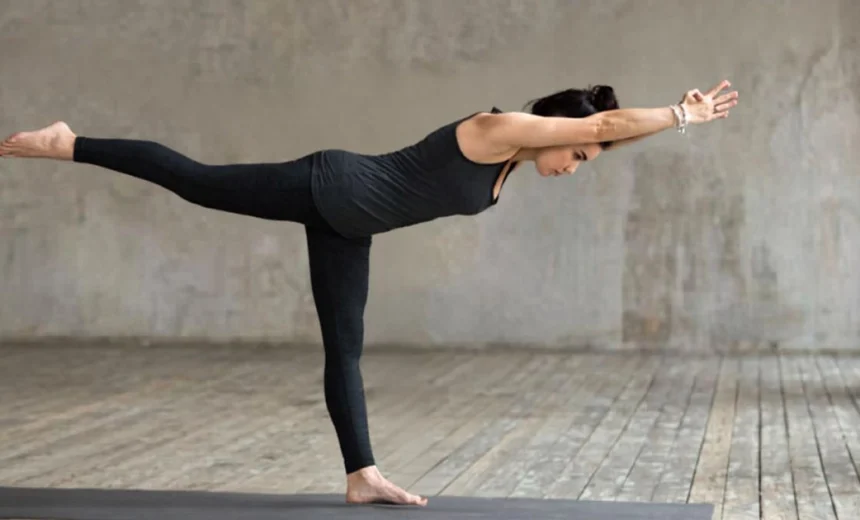
Teachers also help with the strap use, the torso hinge, and the drishti — and can set up appropriate preparatory postures (Warrior III, single-leg balance work, hip flexor stretches) that build the components of Natarajasana before they’re needed all at once.
Cautions and Contraindications
- Lower back injuries: The lumbar extension in the backbend is significant. Work within a comfortable range and don’t push the back leg high if the lower back protests.
- Knee injuries (standing leg): The standing leg’s sustained load under balance challenge can aggravate knee instability. Practice near a wall.
- Shoulder injuries: The arm-reaching-back position is an unusual shoulder orientation. Rotator cuff or labral issues may be aggravated.
- Ankle instability (standing leg): Use a wall for support until the ankle is adequately stable for single-leg balance.
Conclusion
Natarajasana doesn’t arrive. It visits, briefly, and then leaves when the concentration breaks or the balance shifts. The practice is learning to make the visits more frequent and slightly longer, not to pin it down permanently.
That quality of arriving and departing — of catching the pose for a moment before it goes — has something genuinely dance-like about it. The Lord of the Dance is always moving. So is this pose.
FAQS
Q: I keep falling out of Dancer Pose. How do I build balance?
A: Fix your gaze on one still point before you even lift the leg. Then kick back into your hand rather than just holding the foot passively — the active push-pull between the foot and hand creates stability.
Q: My shoulder hurts when I reach the arm overhead in Dancer. What’s wrong?
A: The overhead arm usually means the shoulder is being externally rotated in a position it may not have the mobility for. Back off and work on shoulder flexibility separately before pushing the full expression.
Q: What’s the purpose of kicking into the hand?
A: The backward kick is what opens the pose. Without it, you’re just balancing on one leg. The opposition between the standing leg grounding down and the raised leg kicking back creates the arch and the lift.
Q: Is Dancer Pose good for balance in everyday life?
A: Single-leg balance training has real carryover — proprioception, ankle stability, and hip stability all improve. Dancer Pose works those systems intensely.
Q: How flexible do I need to be for Natarajasana?
A: Moderate to advanced hip flexor flexibility and decent shoulder mobility. Start with the basic version (foot at the hip level) before reaching for the full backbend expression.
Q: Who should avoid this pose?
A: People with shoulder injuries, lower back problems, or ankle instability. Those with serious knee issues should also be careful with the standing leg.