Shishu Asana (Child's Pose)
Table of Contents
- Introduction
- How to Do Shishu Asana
- Benefits
- Tips for Better Practice
- Why Learn with a Yoga Teacher or Instructor
- Cautions and Contraindications
- Conclusion
- FAQS
Introduction
Every yoga teacher says it eventually: “If you need to rest, come into Child’s Pose.” It’s the universal permission slip — drop out of the sequence, breathe, come back when you’re ready.
That reputation as the default rest pose is also why it doesn’t get taken seriously. People collapse into it for ten seconds, think they’ve rested, and push back into the next posture. It becomes a pause button. Which is a waste, because it’s genuinely doing something — assuming you actually stay in it.
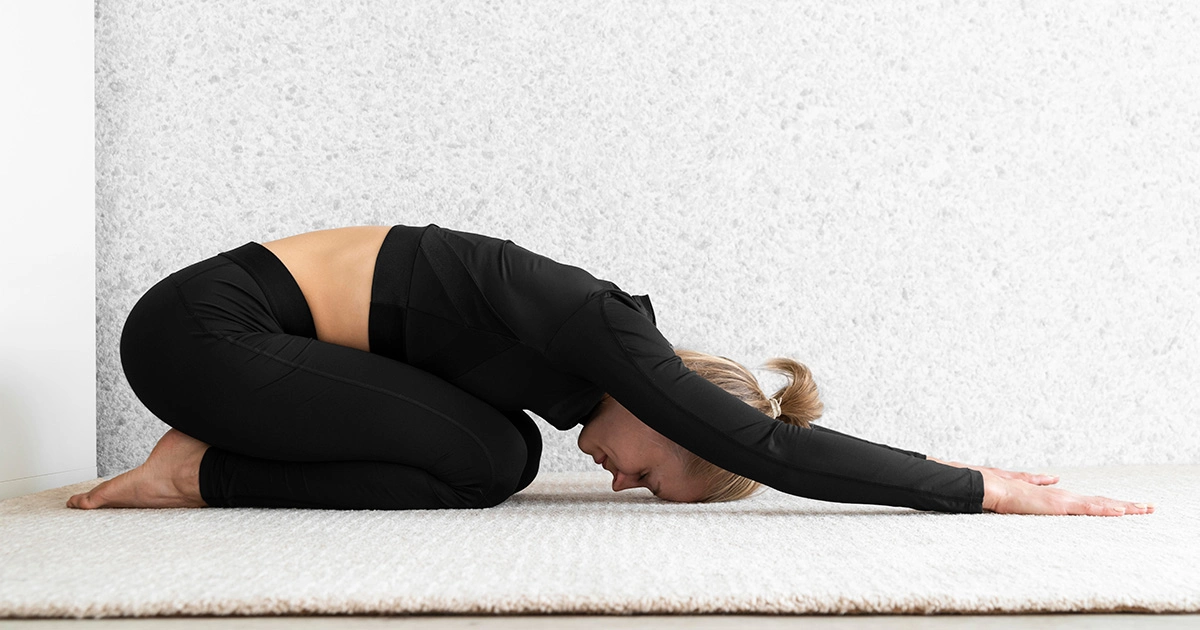
Shishu means child. The shape mimics the fetal resting position: knees bent, hips back toward heels, forehead on the floor. Done properly — meaning with a real hold, not a ten-second cameo — it decompresses the lumbar spine, calms the nervous system, and stretches the hips and lower back in ways that a lot of other poses don’t quite reach.
How to Do Shishu Asana
Start kneeling. Bring the knees together or hip-width apart. Sink the hips back toward the heels and fold the torso forward over or between the thighs. Forehead goes to the floor — or on a block or blanket if the floor isn’t reachable yet.
Arms can go two ways: extended forward alongside the ears for a more active shoulder stretch, or resting alongside the body with palms facing up near the feet for a quieter, more passive shape.
Once you’re in, let the weight go. Forehead down. Shoulders dropped. Belly soft. Breath slower than it was.
Stay for 1 to 5 minutes. Not ten seconds — minutes.
Wide-knee variation: Tight hips often prevent the torso from lowering comfortably between the thighs. Spreading the knees wider solves this — the belly drops through and the fold opens up. This is also the version that works during pregnancy, when the belly needs room.
Benefits
Spinal decompression. The lumbar spine gently flexes in this position, and the vertebrae separate slightly. For anyone spending long hours sitting or standing, this feels tangible within the first minute of a real hold. The key word being real — the nervous system doesn’t shift in ten seconds.
Hip and lower back stretch. The hips flex, the glutes stretch, the muscles along the sacrum and lumbar lengthen. Tight hips respond to this slowly, but they respond. A few honest minutes of Child’s Pose changes how the lower body feels.
Nervous system calming. Forehead down, eyes closed, belly lightly compressed by the thighs — the parasympathetic nervous system gets activated fairly reliably. Heart rate drops. Mental noise quiets. It’s one of the more direct routes to the rest-and-digest state, particularly for people whose stress response runs hot.
Counterpose. After backbends — Ustrasana, Dhanurasana, Chakrasana — the spine wants the opposite direction. Child’s Pose provides it immediately and without effort. After long standing sequences, it gives the legs and back a genuine break rather than just a change of position.
Breath awareness. When the belly presses against the thighs, each inhale becomes visible as the ribs expand sideways and into the back. Diaphragmatic breathing becomes something you feel rather than something a teacher has to describe. That’s more useful than most verbal instruction.
Tips for Better Practice
Stay longer than you want to. Two minutes is where real rest starts. Three is where the hips and lower back actually release. The urge to come out early is usually just restlessness — notice it, stay anyway.
Get a blanket under your forehead. If it doesn’t reach the floor, your neck is working and the pose isn’t restful. Physical comfort here isn’t a luxury — it’s the condition that makes rest possible.
Roll a blanket between the thighs and calves. This is the single most useful modification for people with tight quads or knee discomfort. It changes the pose from something to endure to something that actually works.
Let the shoulders go more than once. In the arms-forward version, people often think they’ve released their shoulders when there’s another layer waiting. Send the shoulder blades outward and let the chest melt. It’s usually there if you look for it.
Breathe into the back body. In Child’s Pose, the back ribs expand on the inhale. Directing breath there turns a passive rest posture into active spinal mobility work — a small shift that changes the texture of the whole thing.
Why Learn with a Yoga Teacher
The point of a teacher in Child’s Pose isn’t instruction — the shape isn’t complicated. It’s what they can do with their hands.
A steady press on the sacrum encourages it toward the floor and heels, deepening the hip and lower back release in a way that’s simply not self-administerable. Hands on the upper back guide breath into the back ribs. A touch on the shoulders gives them permission to drop. These are subtle contacts, but practitioners routinely discover they were holding tension they didn’t know was there — and it takes someone else’s hands to find it.
Cautions and Contraindications
Knee injuries: A blanket roll between the thighs and calves reduces how far the knee flexes. If kneeling causes pain regardless of props, skip the pose.
Pregnancy: Use the wide-knee variation. Later in pregnancy, a bolster under the chest may also help.
High blood pressure: Prolonged holds with the head below the heart may not be appropriate. Check with a doctor for longer stays.
Ankle injuries or stiffness: A rolled blanket under the ankles reduces the plantar flexion demand considerably.
Conclusion
The tendency is to rush through Child’s Pose — treat it as the gap between the real poses, take ten seconds, move on. That misses what’s actually on offer when you stay. The decompression is real. The nervous system shift is real. None of it happens quickly; it needs a few minutes and genuine stillness, which is harder than it sounds.
Most people aren’t that good at stopping. Child’s Pose, done well, practices exactly that.
FAQs
Q: Is Shishu Asana the same as Balasana?
Largely yes — in Indian yoga traditions the names are used interchangeably. Both describe the kneeling forward fold with forehead to the floor.
Q: When should I use Child’s Pose?
Whenever you need to. There’s no rule about when it’s permitted. Tired, dizzy, overwhelmed, or just not ready for the next posture — come into it.
Q: My knees are uncomfortable. What helps?
A folded blanket between the thighs and calves fixes this for most people. If the knees are still uncomfortable, try the wide-knee variation.
Q: Is it actually good for stress and anxiety?
Yes. The combination of forward fold, forehead contact, and slowed breath activates the parasympathetic nervous system — not over weeks of practice, but within the pose itself, in a few minutes.
Q: Can I do Child’s Pose in bed?
You can. A soft mattress changes how the body settles, but the shape still provides spinal flexion and hip opening. Worth doing even without a mat.
Q: Who should avoid Shishu Asana?
People with knee injuries, severe ankle stiffness, or very late pregnancy where even the wide-knee version is uncomfortable.