

Adho Mukha Svanasana-Downward Facing Dog
Adho Mukha Svanasana (Downward Facing Dog)
Table of Contents
- Introduction
- How to Do Adho Mukha Svanasana
- Benefits
- Tips for Better Practice
- Why Learn with a Yoga Teacher or Instructor
- Cautions and Contraindications
- Conclusion
- FAQS
Introduction
Adho Mukha Svanasana is so ubiquitous that an active practitioner likely completes between 5 and 15 repetitions per class. It is foundational to almost all vinyasa yoga poses, yet over a year of regular practice, that high volume can breed a particular kind of carelessness. People stop feeling the pose because they’ve done it so many times that it’s become automatic. The heels hover, the elbows collapse inward, the weight dumps into the wrists, the hips don’t quite reach where they could — and none of it gets noticed because Down Dog stopped being a pose people pay attention to somewhere around session thirty.
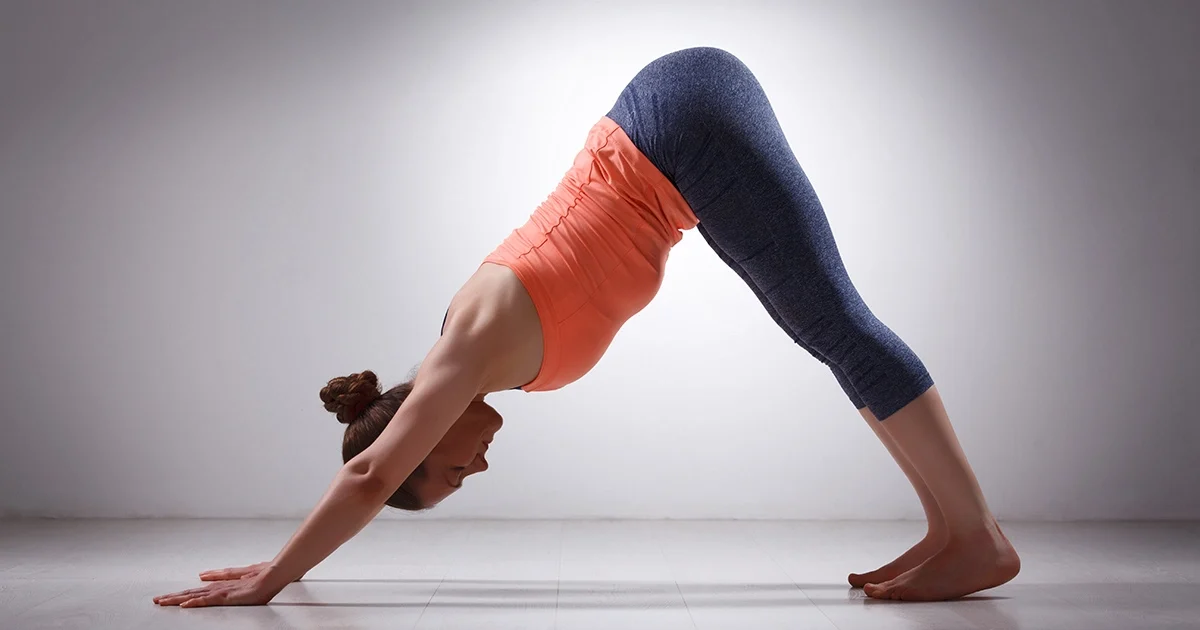
Adho means downward. Mukha means face. Svana means dog. The shape really does look like a dog stretching with its hindquarters elevated. It is a brilliant asset among common yoga inversions (heart above head), functioning as a forward fold — spine in flexion (the forward bending movement that decreases the angle between the bones) relative to the hips — and an arm-strengthening posture (hands bearing significant weight) simultaneously.
Done with genuine attention, it’s one of the most comprehensive single postures in yoga. Done automatically, it’s just something you do between things.
How to Do Adho Mukha Svanasana
Start in a tabletop position — hands under shoulders, knees under hips. Spread the fingers wide and press through all four corners of each hand, particularly the first knuckle of the index finger (which tends to lift). Tuck the toes.
Exhale and press into the hands, lift the knees off the floor, and send the hips up and back. The body creates an inverted V shape — hips at the apex, hands and feet at the base.
Aim for a long, straight spine. The hamstrings will limit this — most people’s heels won’t reach the floor, and that’s fine. Knowing how to do Downward Dog with tight hamstrings simply means prioritizing a long, flat back over straight legs. A slight bend in the knees can help if very tight hamstrings are forcing the lower back to round.
Arms are straight but not locked. Shoulder blades draw together slightly and then widen — the external rotation of the upper arm creates the shoulder-width that the pose needs. The head hangs between the arms, ears in line with the biceps.
Hold for 5 to 10 breaths.
Benefits
Full posterior chain stretch. The hamstrings, calves, glutes, and the muscles along the entire length of the spine all stretch simultaneously. For most people this is the most comprehensive single posterior-chain stretch available in the practice.
Arm and shoulder strengthening. The hands bear a significant portion of body weight in an overhead position. The rotator cuff, deltoids, triceps, and serratus anterior all work to stabilize and maintain the arm position. Over time, consistent Down Dog practice builds meaningful shoulder strength.
Mild inversion benefits. With the heart above the head, blood flows toward the brain and upper body. The calming effect of mild inversions on the autonomic nervous system is real and compounds over regular practice.
Wrist conditioning. The sustained load on the wrists in extension conditions the wrist joint and the flexor and extensor tendons of the forearm. This is preparatory for more demanding arm-balancing postures.
Spinal traction. With the hands pressing the floor and the hips lifting upward, the spine is gently tractioned — the vertebral spaces open slightly as gravity pulls the torso toward the floor between the fixed hands and feet. Many practitioners feel their back decompress in Down Dog in a way that’s immediately noticeable.
Tips for Better Practice
- Press through the first knuckle of the index finger. This is the knuckle that habitually lifts, creating a dead spot in the hand-to-floor connection that loads the outer wrist. Pressing it down distributes the weight more evenly.
- Externally rotate the upper arms. Turn the inner elbow creases to face forward (not inward). This widens the shoulder position and creates the correct shoulder girdle alignment for the pose.
- Bend the knees if the lower back rounds. Soft knees allow the pelvis to tilt forward and the spine to lengthen, which produces more actual spinal stretch than straight-legged Down Dog with a rounded lumbar.
- Let the head hang. The neck shouldn’t be holding any tension. The ears should be in line with the biceps, the head completely released.
- Walk the dog. Alternately bending one knee and then the other — “walking” in the pose — helps open the calves and hamstrings gradually before static holding.
Why Learn with a Yoga Teacher or Instructor
The external rotation of the upper arms is the most technically nuanced alignment point in Down Dog and the hardest to feel without guidance. A teacher can physically adjust the arm rotation, turning the elbow creases forward, which immediately changes the shoulder position and the whole feel of the pose.
Teachers also address the wrist-weight distribution, the index-knuckle pressing, and the relationship between hamstring flexibility and lumbar curve — the interconnected set of decisions that determines whether Down Dog is actually decompressing the spine or just rounding it in a different direction.
Cautions and Contraindications
Wrist injuries or carpal tunnel syndrome: Significant wrist load. Practitioners should explore Downward Facing Dog modifications for wrist pain such as dropping down to Dolphin Pose (forearms on the floor) or using yoga blocks under the hands as modifications.
High blood pressure or late-stage glaucoma: The mild inversion and cardiovascular demand may be contraindicated. Check with a doctor.
Shoulder injuries: The load on the rotator cuff is real. Dolphin Pose removes the wrist extension and shoulder load if needed.
Pregnancy: The pose is generally appropriate during pregnancy with modifications in later trimesters. A wider stance helps accommodate the growing abdomen.
Vertigo: The head-below-heart position can trigger dizziness. Come down immediately if this occurs.
Conclusion
Downward Dog is the posture most yoga practitioners stop really practicing after a few months. It becomes automatic — a shape that happens between other things. That’s a reasonable outcome if you’ve been practicing for years; the body knows the shape.
But there’s always something to find in it. The first knuckle that’s lifting. The upper arm rotation that’s not quite there. The hamstrings that could release a little more if you bent the knees first. The spine that could lengthen more fully with one small adjustment.
A thousand Down Dogs. Each one is an opportunity to pay attention.
FAQS
Q: My heels don’t reach the floor. Am I doing it wrong?
A: No. Heels off the floor is fine and extremely common, especially in the beginning. The priority is a long spine — if you have to round your back to push the heels down, keep them up.
Q: How long should I hold Down Dog?
A: In a Vinyasa flow it’s often 5 breaths. In a more exploratory practice, 1 to 2 minutes lets the shoulders and hamstrings open more fully. Neither is wrong.
Q: My wrists hurt in Down Dog. Is that normal?
A: Common, but worth addressing. Spread the fingers wide, press into the base of each finger, and shift a little more weight toward the upper hand. Regular wrist mobility work helps a lot.
Q: Is Down Dog a rest pose or an active pose?
A: Both, depending on where you are in your practice. For beginners it’s demanding. For experienced practitioners it genuinely becomes a resting pose between more intense postures.
Q: Should my back be flat in Downward Dog?
A: A long, neutral spine is the goal. Not necessarily flat — the natural lumbar curve is fine. What to avoid is rounding the upper back or collapsing into the shoulder joints.
Q: Can I do Down Dog every day? A: Yes. Many practitioners consider it a daily maintenance pose for shoulders, hamstrings, and spinal length. It’s worth doing even on low-energy days.
Q: Why do my arms shake in Down Dog?
A: Shoulder stabilizer fatigue — common in earlier practice. It improves. Focus on pressing the floor away with straight arms rather than passively hanging in the shoulder joints.